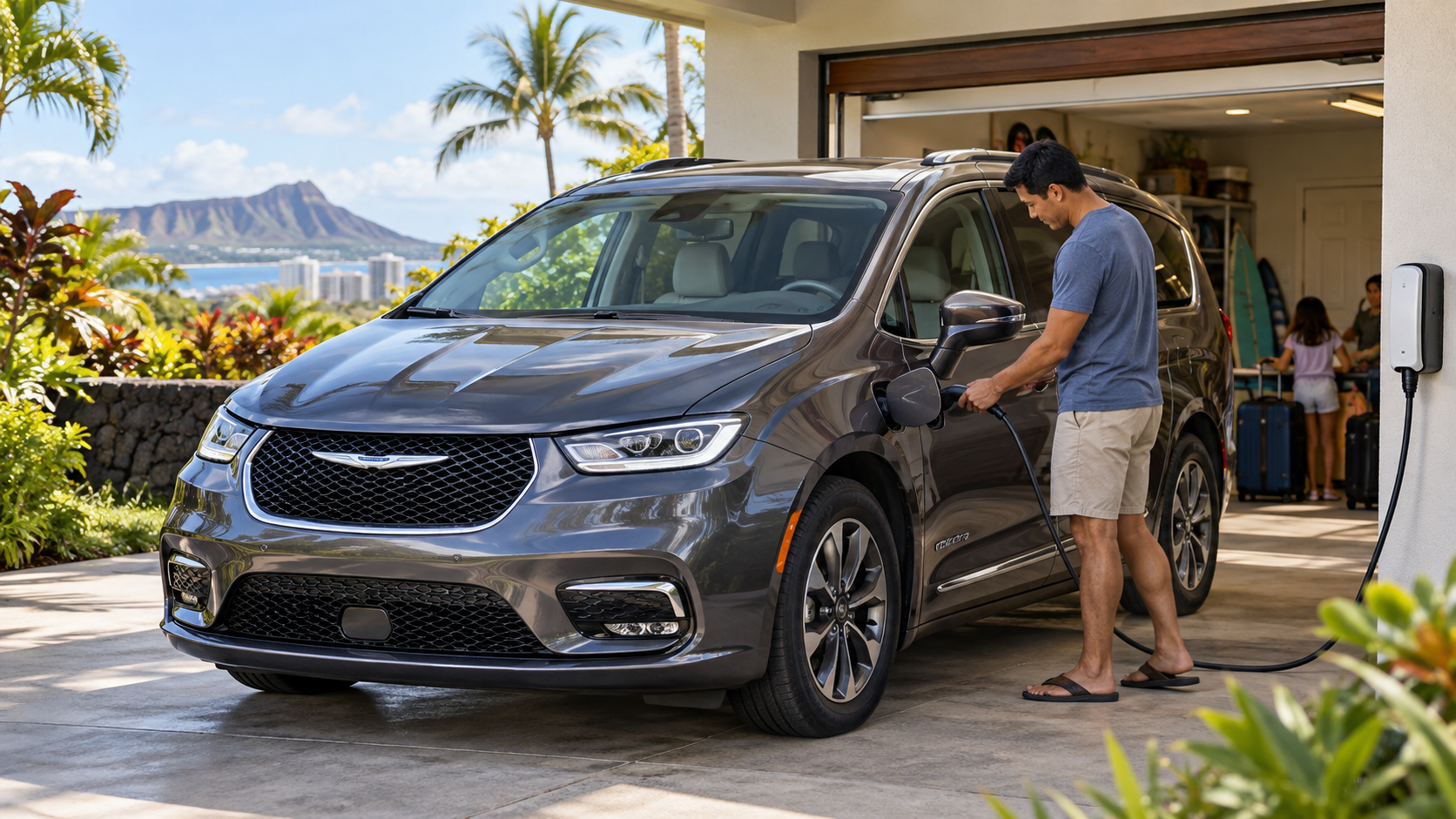





The Chrysler Pacifica Hybrid combines electric driving with gasoline power, giving families two energy sources for trips across Oahu. Its rechargeable battery supports electric travel, while the gasoline engine provides power when the vehicle needs it. But how does charging work, and what happens when the available electric range runs out? The answers start with how the minivan manages electricity and gasoline during a trip. For Honolulu households, charging access and trip distance can change how much gasoline the Pacifica Hybrid consumes. Therefore, understanding electric range, fuel economy, and charging requirements is essential when evaluating this plug-in hybrid minivan. How the Chrysler Pacifica Hybrid Combines Electric and Gasoline Power The Chrysler Pacifica Hybrid uses a gasoline engine, electric motors, and a rechargeable high-voltage battery. Unlike a conventional gasoline minivan, it can travel using electricity stored through external charging. The battery supplies energy to the electric motors, which turn electrical energy into mechanical power for propulsion. Meanwhile, the gasoline engine provides another source of power when the vehicle needs it. How does the Chrysler Pacifica Hybrid switch between electricity and gasoline? Its electronic controls manage both power sources automatically using battery charge, acceleration demand, and operating requirements. For instance, the minivan may travel using electricity during a short neighborhood trip with sufficient battery charge. However, the gasoline engine can start when the powertrain requires more assistance. The driver does not need to manually switch between electric and gasoline driving. Instead, the vehicle manages propulsion while the family continues traveling. The engine may start even when the battery still holds usable charge. Therefore, having electric range available does not guarantee gasoline-free travel on every trip. This distinction matters when comparing the plug-in hybrid with a gasoline Chrysler Pacifica. The gasoline model relies on fuel for propulsion, while the plug-in hybrid can replace some gasoline miles with electricity. For families making short trips between home, school, and shopping destinations, charging creates an opportunity to use stored electrical energy. However, the amount of gasoline consumed still reflects how far the minivan travels and how the powertrain operates. What Happens When the Pacifica Hybrid Runs Out of Electric Range The Chrysler Pacifica Hybrid does not stop when its available electric driving range reaches zero. Instead, the gasoline engine supports continued travel through conventional hybrid operation. What happens when the Pacifica Hybrid battery runs out? The minivan continues driving on gasoline while maintaining a reserve of battery energy for normal hybrid functions. A dashboard reading of zero remaining electric miles does not mean the high-voltage battery contains no electricity. The battery management controls retain an operating reserve for hybrid driving. Consequently, the electric motors can continue assisting the gasoline engine. The driver can complete the trip without stopping immediately to connect a charger. This also explains why the Pacifica Hybrid differs from a fully electric vehicle. An electric-only vehicle requires replenished battery energy to continue driving. The Pacifica Hybrid retains gasoline propulsion after its available plug-in charge runs down. However, gasoline consumption becomes more prominent when the battery can no longer support extended electric driving. Consider a family traveling beyond Honolulu for a full day of activities. The minivan may begin the day using electrical energy stored during overnight charging. After the available electric miles are used, gasoline supports the remaining distance. For this reason, shoppers should evaluate electric range separately from total driving distance. Electric range indicates how far the battery may support electric travel. Total range accounts for the combination of a charged battery and gasoline in the fuel tank. Does the Chrysler Pacifica Hybrid Charge While Driving? The Chrysler Pacifica Hybrid recovers some electrical energy while slowing through regenerative braking. However, that process does not replace external charging for replenishing the plug-in battery. During regenerative braking, the electric motor acts as a generator. It converts part of the vehicle's motion into electrical energy and returns that energy to the battery. Does the Pacifica Hybrid recharge itself while driving? It recovers energy during deceleration, but drivers still need external charging to restore substantial plug-in electric range. The amount recovered changes with braking demand, battery charge, and the amount of energy available during deceleration. Therefore, regenerative braking cannot guarantee that the battery will regain the electricity consumed earlier in the trip. How External Charging Works External charging transfers electricity from a compatible charging source into the battery. Families can use a suitable household outlet or compatible Level 2 charging equipment. The Chrysler Pacifica Hybrid has three charging and energy recovery methods worth distinguishing: Level 1 charging uses a compatible 120-volt household outlet. A full charge takes approximately 14 hours, making overnight charging worth considering for households with suitable parking. Level 2 charging uses compatible 240-volt equipment. Under suitable charging circumstances, a full charge takes approximately two hours, reducing the time needed between trips. Regenerative braking captures some energy when the minivan slows. It supplements battery energy during driving but cannot replace the substantial electrical input available through a plug-in connection. Charging time varies with battery charge level and the electrical equipment used. Additionally, household electrical installations should meet the charging equipment's requirements. For Honolulu residents, parking access deserves attention. A dedicated parking space near a compatible outlet may make overnight charging straightforward. However, families using shared parking should confirm whether reliable charging access is available before selecting a plug-in hybrid. Charging also requires no gasoline at the charging location. Instead, the household purchases electricity to replenish the battery. The cost of that electricity should become part of the family's transportation budget. Understanding Pacifica Hybrid Electric Range and Gasoline Use The Chrysler Pacifica Hybrid has two range measurements that answer different questions. Electric range describes travel using stored battery energy. Total range includes the distance available from both electricity and gasoline. Chrysler published an estimated 32 miles of all-electric range for the Pacifica Plug-in Hybrid. The manufacturer also published an estimated combined driving range of 520 miles. These figures represent standardized estimates. Actual distance varies with driving speed, accessory demand, terrain, battery charge, and other operating factors. What happens to gasoline consumption when the electric miles are depleted? The minivan continues as a gasoline hybrid, with the engine supplying much of the energy needed for travel. Why MPGe and MPG Are Different MPGe means miles per gallon equivalent. It expresses electrical energy consumption using the energy equivalent of one gallon of gasoline. Chrysler Pacifica Hybrid specifications included an EPA rating of 82 MPGe for combined electricity and gasoline operation. The published gasoline-only combined rating was 30 MPG. These measurements should not be treated as interchangeable. MPGe describes energy efficiency when electricity contributes to travel. MPG measures miles traveled per gallon of gasoline. For instance, a family driving short distances after charging may purchase less gasoline than a family traveling farther without recharging. However, electricity still carries a cost, and gasoline remains necessary for longer trips. Therefore, estimating operating expenses requires more than looking at the MPGe rating. Families should review their daily mileage, gasoline prices, electricity rates, and charging frequency. A fair comparison also considers the standard gasoline Pacifica. That minivan does not require external charging, but gasoline supplies all propulsion energy. Shoppers comparing these powertrains should consider how much driving could take place using a charged battery. They should also calculate the cost of electricity used to replace gasoline miles. What Honolulu Families Should Consider Before Choosing a Pacifica Hybrid The Chrysler Pacifica Hybrid may suit households that can charge at home and complete a substantial portion of their travel using electricity. However, driving distance and access to charging should guide the evaluation. Oahu travel includes neighborhood streets, highway trips, hills, and varying traffic levels. These factors can change energy consumption, so a published range figure should remain a planning reference. Before selecting a Pacifica Hybrid, families should examine three ownership considerations: Home charging access establishes how easily the battery can regain electricity between trips. Confirm that parking arrangements and electrical equipment support a dependable charging routine. Household driving distances indicate how much travel might fit within the estimated electric range. Compare school routes, work commutes, errands, and longer island outings. Electricity and gasoline expenses reveal the cost of using both energy sources. Compare local electricity rates, gasoline prices, and expected charging frequency without assuming guaranteed savings. A family with overnight charging and shorter commuting distances may use electric propulsion for a substantial share of local trips. Conversely, a household without charging access will rely more heavily on gasoline hybrid operation. The Pacifica Hybrid is also no longer in production. Therefore, shoppers interested in this powertrain should verify pre-owned availability and review the specific vehicle's model year and history. Families interested in current alternatives can browse new Chrysler inventory or all new vehicles. These pages provide a starting point for comparing available models without assuming a new Pacifica Hybrid is in stock. Additionally, the dealership's finance department can provide information about available financing options. Shoppers can also contact Cutter Chrysler Dodge Jeep Ram Fiat Honolulu with questions about vehicle availability. Before making a decision, consider where the minivan will charge and how far your household travels between charging opportunities. Those details provide a clearer foundation for evaluating electric miles, gasoline purchases, and family transportation needs across Oahu.