





Many truck shoppers start with a simple question: should I buy a Ram 1500 or move up to a Ram 2500. The problem is that capability numbers can look straightforward while the real difference between these trucks is mechanical. A half-ton truck and a heavy-duty truck are not separated by badges alone. They are built around different assumptions about how much weight the truck will carry, how often it will tow, and how much daily comfort the buyer is willing to trade for higher load control. To choose correctly, shoppers need more than a spec comparison. They need to understand how payload, frame strength, suspension tuning, and torque delivery actually change what the truck does in real use.
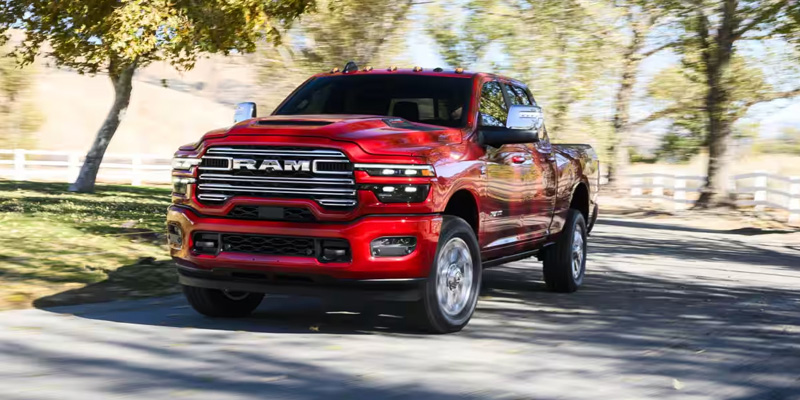
Payload vs Towing and Why They Are Not the Same Decision
Many buyers comparing the Ram 1500 and Ram 2500 ask what matters more, payload or towing. Payload is the amount of weight a truck can carry on its own structure, including passengers, cargo in the bed, and trailer tongue weight. Towing is the amount of weight the truck can pull behind it on a trailer. Those numbers are connected, but they do not measure the same task.
This distinction matters because many buyers focus on trailer weight and ignore how much weight is being placed on the truck itself. A trailer may be within the truck’s towing rating, but the tongue weight, passengers, tools, and cargo can still push the truck toward its payload limit. That is one of the main reasons some buyers end up in the wrong truck class.
The 2026 Ram 1500 payload capacity is built for buyers whose work and towing needs stay in the lighter to moderate range. The 2026 Ram 2500 payload capacity is designed for heavier sustained loads, which means the truck structure, axle ratings, and suspension are meant to tolerate more weight placed directly on the truck. When shoppers understand that payload governs what the truck is carrying while towing governs what it is pulling, the comparison becomes much more accurate.
Shoppers comparing the Ram 1500 and Ram 2500 should evaluate:
- how much bed cargo the truck will carry on workdays
- how many passengers or tools are typically in the cab
- how much trailer tongue weight will transfer onto the truck
- whether the truck’s heavier tasks are occasional or routine
That is the first threshold where capability requirements begin to change. Buyers who only think about trailer size often miss the load the truck itself has to support.
How Frame Strength Changes What the Truck Can Carry and Pull
Many shoppers ask what the real difference is between a Ram 1500 and a Ram 2500 if both can tow and haul. The answer begins with frame design. A truck frame is the structural foundation that supports the cab, bed, suspension, drivetrain, and the forces created by cargo and trailers. When capability increases, the frame must resist more bending and twisting under load.
The 2026 Ram 1500 frame is engineered to balance strength with ride quality and everyday drivability. That matters because a half-ton truck is often used as both a work vehicle and a daily driver. The structure still needs to manage load, but it is tuned for broader use.
The 2026 Ram 2500 frame is built around higher sustained stress. As payload and trailer demand rise, the truck experiences more vertical loading from cargo, more rearward pull from the trailer, and more chassis stress during braking, acceleration, and uneven road movement. A more rigid heavy-duty frame helps distribute these forces without the same degree of flex.
That difference affects real-world behavior in several ways. A stronger heavy-duty structure helps the truck remain more stable with heavier loads, improves confidence when the trailer shifts weight, and supports higher-rated suspension and axle components. This is why buyers moving from occasional towing into heavier recurring work often notice that a three-quarter-ton truck feels more composed under strain even if it feels less relaxed when empty.
For shoppers, the important question is not whether the Ram 2500 is stronger in general. It is whether the kind of work being asked of the truck actually requires that stronger structural foundation often enough to justify it.
How Suspension Design Changes Ride Quality and Load Control
Many buyers wondering whether a Ram 2500 is worth it for daily driving are really asking about suspension behavior. Suspension is the system of springs, dampers, and related components that supports the truck’s weight, absorbs road impacts, and controls body movement. The way that system is tuned determines how the truck behaves both unloaded and under load.
The 2026 Ram 1500 suspension system is designed with daily comfort as a major priority. A half-ton truck needs to manage commutes, errands, highway driving, and light to moderate work without constantly feeling stiff or overbuilt. That means its suspension is tuned to absorb small road inputs more smoothly and maintain a more settled ride when the truck is not carrying significant weight.
The 2026 Ram 2500 heavy-duty suspension is built with a different priority. Its job is to control more weight, resist sag under load, and maintain stability when cargo or trailer forces increase. To do that, the system has to be firmer and more load-focused. That typically means the truck feels more planted when working hard, but less forgiving when it is unloaded.
This is where many buyers overbuy capability. They assume more truck automatically means better truck, but suspension tuning always involves compromise. A heavy-duty suspension improves control with heavy loads because it resists compression and body movement more aggressively. The tradeoff is that when the truck is empty, that same stiffness can feel less comfortable than a half-ton setup.
For daily-use buyers, the decision usually comes down to how often the truck will work near its upper limits. If most miles are unloaded, the 2026 Ram 1500 suspension system usually makes more sense. If heavy cargo or towing happens regularly enough that stability under load matters more than unloaded comfort, the 2026 Ram 2500 heavy-duty suspension becomes easier to justify.
How Engine Torque Changes Towing Performance
Many shoppers comparing truck capability ask whether a Ram 2500 is better for towing than a Ram 1500. The answer depends partly on torque. Torque is the rotational force produced by the engine and delivered through the transmission and axles to move the truck and trailer. In towing, torque matters because the truck is not just trying to accelerate itself. It is trying to move additional mass from a stop, maintain speed under load, and handle grades without constant strain.
The 2026 Ram 1500 engine torque output is suited to light and moderate towing where daily drivability still matters. It can move trailers effectively, but it is doing so within a truck class designed to remain more versatile when unloaded.
The 2026 Ram 2500 torque delivery is built for heavier work. Higher torque, combined with heavy-duty gearing and drivetrain components, helps the truck apply pulling force more consistently when trailer weight increases. This matters most when starting from a stop, climbing hills, merging with a load, or maintaining control when the trailer begins to influence the truck’s momentum.
Buyers often confuse horsepower and torque in this comparison. Horsepower helps describe how quickly work can be done over time. Torque explains how much turning force is available to get the load moving and keep it moving under resistance. When towing requirements grow, torque becomes more important because heavier loads create more resistance at low and mid-range speeds.
That is why a heavy-duty truck feels different with a serious trailer attached. It is not only stronger on paper. Its drivetrain is calibrated for the kind of sustained pulling force that repeated towing demands.
When a Ram 1500 Is Enough and When a Ram 2500 Becomes Necessary
The most important question in this comparison is not which truck is more capable. It is when capability requirements actually change enough to justify moving from a Ram 1500 to a Ram 2500.
The 2026 Ram 1500 is usually the right choice when the truck will spend a large part of its life as a daily driver and its work demands stay in the light to moderate range. It makes sense for buyers who tow recreational trailers occasionally, carry tools or supplies without consistently pushing payload limits, and want a truck that remains easier to live with when unloaded. In that role, the Ram 1500 gives buyers enough working capability without forcing them into heavy-duty tradeoffs every day.
The 2026 Ram 2500 becomes necessary when workload stops being occasional and starts becoming structural to how the truck is used. That change usually happens when payload becomes consistently heavy, trailer weight becomes more demanding, or towing becomes frequent enough that frame rigidity, firmer suspension control, and stronger torque delivery all matter on a regular basis. At that point, the truck is no longer being asked to occasionally do heavy-duty work. It is being asked to function as a heavy-duty truck.
A useful decision framework looks like this:
- choose the 2026 Ram 1500 when comfort, versatility, and moderate work are the real priority
- choose the 2026 Ram 2500 when the truck will regularly manage heavier cargo, heavier trailers, or more sustained towing stress
- move up to the heavy-duty class when payload, trailer tongue weight, or recurring towing strain starts shaping how the truck must behave, not just what it might do once in a while
That is when capability requirements actually change. The move from a Ram 1500 to a Ram 2500 is justified not by wanting the biggest number available, but by reaching the point where the truck’s structure, suspension, and torque strategy all need to be built around heavier work. When buyers understand that threshold clearly, they can choose the truck that fits both the job and the day-to-day drive.
Connect with us


- June 2026
- May 2026
- April 2026
- May 2024
- March 2024
- February 2024
- December 2023
- November 2023
- October 2023
- September 2023
- August 2023
- July 2023
- June 2023
- May 2023
- April 2023
- March 2023
- February 2023
- January 2023
- December 2022
- November 2022
- October 2022
- September 2022
- August 2022
- July 2022
- June 2022
- May 2022
- April 2022
- March 2022
- February 2022
- January 2022