





The Jeep Compass vs Cherokee decision looks simple until you apply it to where you drive every day. On Oahu, the variables that separate these two models are not the same ones that dominate mainland comparisons. Highway segments are short. Surface streets are dense. Parking is tight. Rain arrives without warning on the Pali and the H-3. Beach runs, airport pickups, and family errands define the weekly schedule for most island drivers, and neither a spec table nor a lifestyle photo communicates how either Jeep handles those demands. This guide walks through the real differences between the Compass and the Cherokee in the context of daily driving in Honolulu, so the comparison points to something more useful than a number on a window sticker.
Size, Platform, and What It Means on Oahu Streets
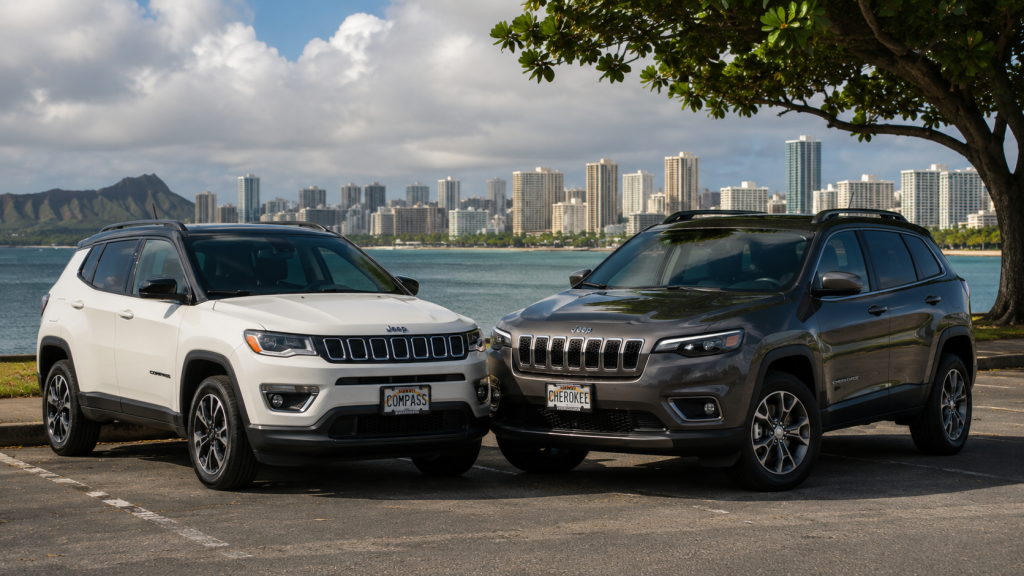
The Compass and the Cherokee share Jeep branding but not a platform. The Compass sits on a front-wheel-drive-based architecture that prioritizes a smaller footprint and lighter curb weight. The Cherokee uses a more substantial unibody setup that gives it a wider stance, more interior volume, and a ride character that leans toward composed highway travel. On paper, the Cherokee is the roomier and more capable package. On the streets of Kaimuki, Manoa, or downtown Honolulu, the Compass’s smaller dimensions become an advantage in ways the spec sheet does not capture.
The Compass measures roughly eight inches shorter in overall length than the Cherokee. That gap matters when navigating the multi-level parking structures near Ala Moana, squeezing into street parking in Chinatown, or making tight turns in residential neighborhoods built around pre-war lot sizes. The Cherokee is not a large SUV by national standards, however its extra length and width require more spatial awareness in exactly the driving contexts Honolulu presents most frequently. Drivers who cover urban routes daily will notice the Compass’s smaller profile as a tangible asset, not a compromise.
The platform difference also shapes ride feel. The Compass absorbs the choppy pavement common on older Honolulu surface streets with a lighter, more car-like response. The Cherokee delivers more substantial isolation at higher speeds, which rewards drivers who spend more time on H-1 or H-3 segments. Neither character is wrong. However, a driver whose route is mostly urban will find the Compass’s lighter touch more comfortable across a typical day.
Fuel Economy in Stop-and-Go Traffic
Fuel economy figures from the EPA reflect controlled testing on a standard drive cycle that does not resemble Honolulu traffic. The Compass with its standard 2.0-liter four-cylinder returns competitive city numbers, and those numbers hold up reasonably well in stop-and-go patterns because the engine displacement is modest and the transmission is tuned for low-speed efficiency. The Cherokee’s available engine options, including the 2.0-liter turbocharged four-cylinder and the 3.2-liter V6, produce stronger output but consume more fuel per mile when the powertrain is working through repeated acceleration and braking cycles.
The core question for an Honolulu driver is how many miles per gallon each model delivers on a commute that mixes H-1 freeway segments with surface street driving in Kalihi, Moiliili, or Hawaii Kai. The Compass’s smaller engine loses less efficiency in that mixed pattern. The Cherokee’s turbocharged four-cylinder recovers some efficiency through its engineering, however it carries more vehicle weight through the same cycle. For a driver covering forty to sixty miles daily in a mix of freeway and surface street patterns, the Compass’s fuel advantage is real and adds up across a monthly fuel budget in Hawaii, where gas prices run above mainland averages year-round.
Cargo Space and Interior for Island Life
The Cherokee carries a clear cargo advantage over the Compass. Behind the second row, the Cherokee offers roughly 25 cubic feet of cargo space compared to the Compass’s 20 cubic feet. With rear seats folded, that gap widens further. For drivers whose weekly routine includes airport runs with multiple bags, beach days with boards or coolers, or Costco trips that fill the back end, the Cherokee’s additional volume is a functional difference that the Compass cannot fully close. However, context matters. Several island-specific loading scenarios fall squarely within what the Compass manages without difficulty:
- Grocery runs and weekly errands fit comfortably in the Compass’s cargo area. The hatch opening is wide, the floor is flat, and everyday island shopping does not push the model’s capacity.
- Snorkeling gear, beach chairs, and soft coolers load without issue into the Compass. Surfboards and paddleboards require a roof rack on either model, so the comparison narrows when overhead carry is part of the plan.
- Airport pickups with two or three passengers and standard luggage sit within the Compass’s range. Four passengers with checked bags and carry-ons can stress the available space, which is where the Cherokee’s additional cubic footage becomes worth having.
The Cherokee’s interior also offers more rear legroom, which matters for families or frequent carpoolers covering longer island routes. The Compass rear seat is comfortable for shorter adults on moderate trips but will feel tighter on a sixty-minute drive to the North Shore with full-grown passengers. For solo commuters or couples, that distinction is largely irrelevant.
AWD and Wet-Road Relevance in Hawaii
All-wheel drive carries different meaning in Hawaii than it does on the mainland. Neither the Compass nor the Cherokee will see snow, and true off-road terrain is accessible to very few Oahu routes. The relevant traction scenario for most Honolulu drivers is rain-slicked pavement, which arrives quickly and unpredictably on the windward side, along the Pali Highway, and through the H-3 tunnel corridor. In that situation, AWD provides a real margin of grip during acceleration on wet asphalt, particularly on grades and curved exit ramps.
Both the Compass and the Cherokee offer AWD configurations. The Compass carries available AWD across several trim levels, and Jeep’s Active Drive system on the Cherokee manages torque distribution across axles without driver input. For daily Honolulu driving, the AWD question is less about which system is more sophisticated and more about whether the buyer prioritizes wet-weather grip on mountain routes. A driver who commutes along the H-1 corridor through Honolulu’s leeward side in mostly dry weather will find front-wheel drive on either model sufficient. A driver who crosses the Koolau Range on the Pali or H-3 regularly, where rain is frequent and pavement grades are steep, gets a real grip margin from AWD that justifies the configuration upgrade on either model.
Which Driver Profile Fits Each Model
The strongest way to close this comparison is to match each model to the driver profile it serves most naturally. The Compass and the Cherokee are not interchangeable at a lower and higher price point. They are structured around different daily use assumptions, and the right answer follows from which assumption fits the buyer’s life in Honolulu more closely. At Cutter Chrysler Jeep Dodge Ram Honda in Honolulu, both models are available and the team is familiar with the driving patterns, routes, and priorities most relevant to Oahu buyers.
- The Compass fits a driver who covers urban routes daily, parks in tight structures or on residential streets, and does not regularly carry more than two or three passengers with moderate cargo. The smaller footprint, lighter fuel draw, and car-like handling make it the more natural fit for dense Honolulu commuting.
- The Cherokee fits a driver who covers longer island routes, carries a full family or frequent passengers on back-seat trips, needs the additional cargo room for gear-heavy island activities, or prioritizes a more planted, composed feel on freeway segments and mountain passes.
- Either model works well with AWD for drivers who cross the Koolau Range on the Pali or H-3 with any frequency. For drivers who stay primarily on the H-1 corridor and south Oahu surface streets, the front-wheel-drive configuration on the Compass is a reasonable and more fuel-efficient choice.
Connect with us


- July 2026
- June 2026
- May 2026
- April 2026
- May 2024
- March 2024
- February 2024
- December 2023
- November 2023
- October 2023
- September 2023
- August 2023
- July 2023
- June 2023
- May 2023
- April 2023
- March 2023
- February 2023
- January 2023
- December 2022
- November 2022
- October 2022
- September 2022
- August 2022
- July 2022
- June 2022
- May 2022
- April 2022
- March 2022
- February 2022
- January 2022